CHAPTER 2 — CHOOSING THE RIGHT TREE (IT’S NOT JUST A PRETTY TRUNK)


CHAPTER 2 — CHOOSING THE RIGHT TREE
(IT’S NOT JUST A PRETTY TRUNK)
From Forest to Kitchen: The Chonky Wonky Wood Way
© ChonkyWonkyWood Ltd. All rights reserved.
Most people think choosing wood is simple.
They imagine Jason and Jon strolling into a forest, pointing at a random tree like they’re picking a sandwich from a menu, and saying:
“Yep. That one. Chop it down. Let’s make a board.”
If only.
Choosing the right tree is part science, part instinct, part experience… and part sheer stubbornness.
It’s a dance between nature and craftsman, and the forest always leads.
The Forest Doesn’t Give Up Its Best Easily
Jason and Jon don’t cut down trees for fun.
They don’t wander into the woods with axes like two lumberjack wannabes on a weekend adventure.
Every piece of timber they use comes from trees already marked for felling — trees that have reached the end of their natural cycle, trees that need to come down for woodland health, or trees that have been damaged by storms, disease, or time.
They rescue wood that would otherwise be burned or left to rot.
It’s not just sustainable.
It’s respectful.
It’s part of the Chonky Wonky promise:
Give fallen giants a second life.
Not All Trees Are Created Equal
A tree might look majestic from the outside — tall, proud, thick trunk, leaves fluttering like it’s posing for a woodland photoshoot — but inside?
Inside it might be chaos.
Cracks.
Rot.
Warping.
Insect tunnels.
Moisture pockets.
Grain that twists like a drunk snake.
Jason and Jon have seen it all.
Some trees are perfect on the outside and absolute nightmares on the inside.
Some look wonky and wild but hide the most beautiful grain you’ve ever seen.
It’s like dating.
You can’t judge by appearances alone.
The First Test: Species
Jason and Jon work with British hardwoods — the good stuff.
The sturdy stuff.
The stuff that can handle a lifetime of chopping, slicing, serving, and showing off in someone’s kitchen.
Their favourites?
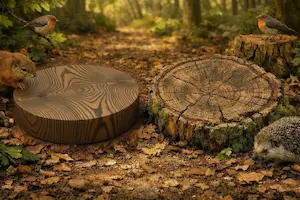
Oak
Strong.
Bold.
Stubborn.
The diva of the hardwood world.
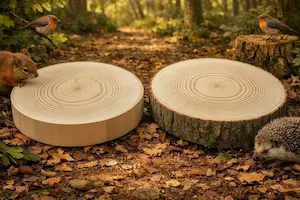
Ash
Flexible.
Reliable.
A grain pattern that looks like it’s been sketched by an artist.
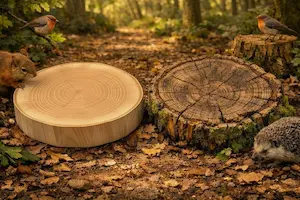
Beech
Smooth.
Elegant.
The “posh cousin” of the hardwood family.
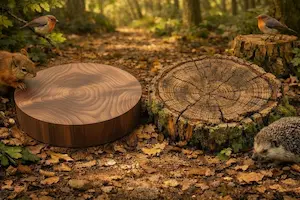
Walnut
Dark.
Moody.
Sexy.
The James Bond of timber.
Cherry
Warm.
Rich.
A colour that deepens with age like a fine whisky.
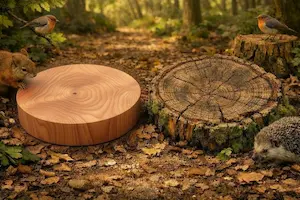
Jason and Jon choose based on what the wood wants to become — not what they want it to be.
The Second Test: Character
This is where the Chonky Wonky philosophy kicks in.
Most woodworkers chase perfection.
Jason and Jon chase character.
Knots? Beautiful.
Curves? Charming.
Splits? A chance for creativity.
Wonky edges? A signature.
They don’t force wood into straight lines and perfect rectangles.
They let the wood guide the shape.
If a plank curves, they follow it.
If a knot demands attention, they highlight it.
If a split needs stabilising, they fill it with food‑safe epoxy that turns a flaw into a feature.
Every board is unique because every tree is unique.
The Third Test: History
Trees live long lives.
Decades.
Centuries.
They survive storms, droughts, floods, frost, heatwaves, and the occasional squirrel uprising.
All of that becomes part of the grain.
Jason and Jon look for wood with a story — wood that has lived, wood that has endured, wood that has something to say.
A board isn’t just a board.
It’s a biography.
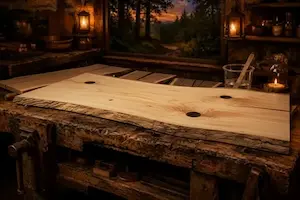
The Fourth Test: Potential
This is where instinct takes over.
Jason will pick up a slab of timber, tilt his head, squint, and say:
“This one’s going to be a serving board.”
Jon will pick up another, run his fingers along the grain, and mutter:
“This one’s a chopping board. Big one. Proper chonky.”
They don’t always agree.
Sometimes they argue.
Sometimes they swap pieces halfway through.
Sometimes they both stare at a plank for ten minutes before one of them finally says:
“I’ve got it.”
And when they do?
Magic happens.
The Fifth Test: The Wonky Factor
This is the secret ingredient.
Chonky Wonky Wood isn’t about straight lines and perfect symmetry.
It’s about embracing nature’s quirks.
A board with a curve?
That’s personality.
A board with a knot?
That’s history.
A board with a split filled with shimmering epoxy?
That’s art.
Jason and Jon don’t fix imperfections.
They celebrate them.
Because perfection is boring.
Wonky is wonderful.
The Sixth Test: The Future Kitchen
When choosing wood, Jason and Jon don’t just think about the workshop.
They think about the kitchen it will end up in.
Will this board hold a Sunday roast?
Will it carry a mountain of cheese?
Will it be the centrepiece of a charcuterie feast?
Will it be used every day or saved for special occasions?
They imagine the board’s future life.
Its purpose.
Its destiny.
And that helps them choose the right timber for the right job.
The Seventh Test: The Feel
This is the most important test of all.
Jason and Jon pick up the wood.
They hold it.
They feel the weight.
They trace the grain.
They listen to what the wood is telling them.
Because wood speaks.
Not in words.
But in texture, weight, warmth, and energy.
Some pieces feel alive.
Some feel stubborn.
Some feel ready.
Jason and Jon trust their hands.
Their instincts.
Their connection to the craft.
The Tree’s Journey Begins
Once the right tree is chosen — once the species, character, history, potential, wonky factor, future purpose, and feel all align — the journey begins.
The tree leaves the forest.
It becomes timber.
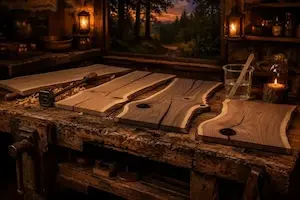
It becomes slabs.
It becomes planks.
And then it arrives at the workshop.
Where Jason and Jon take over.
Where the transformation truly begins.
Where the forest’s story becomes a kitchen story.
And that…
is where Chapter 3 begins.