CHAPTER 3 — THE JOURNEY OUT OF THE WOODS From Forest to Kitchen: The Chonky Wonky Wood Way

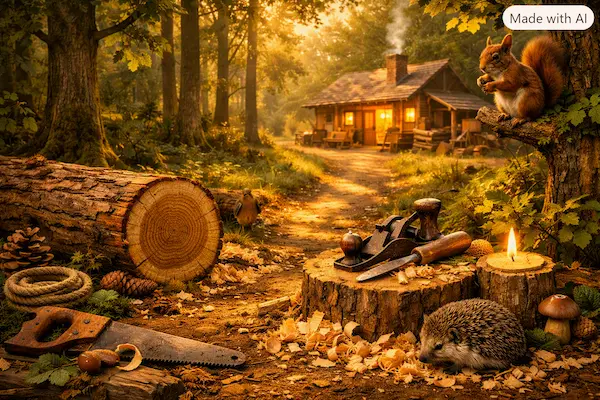

CHAPTER 3 — THE JOURNEY OUT OF THE WOODS
From Forest to Kitchen: The Chonky Wonky Wood Way
© ChonkyWonkyWood Ltd. All rights reserved.
Leaving the forest is a bit like leaving home for the first time.
The tree has spent decades—sometimes centuries—rooted in one place, weathering storms, feeding wildlife, soaking up sunshine, and quietly building the grain patterns that Jason and Jon will one day fall in love with.
But eventually, every tree marked for felling reaches its moment.
Not a moment of destruction—no.
A moment of transformation.
This chapter is about that moment.
The transition.
The journey.
The shift from woodland giant to future kitchen hero.
The Forest Doesn’t Let Go Easily
When a tree is felled, the forest reacts.
Birds scatter.
Leaves tremble.
The ground gives a soft, earthy sigh.
Jason and Jon have always respected this moment.
They don’t see a fallen tree as “timber.”
They see it as a life entering a new chapter.
And because they only work with trees already marked for removal—trees that need to come down for woodland health, safety, or natural decline—the moment is bittersweet, not tragic.
The forest isn’t losing a tree.
It’s passing one on.
The First Cut: A Moment of Truth
Once a tree is felled, the first cut reveals everything.
Jason and Jon aren’t usually there for the felling itself—they work with trusted suppliers who specialise in sustainable woodland management—but they are there for the moment the timber arrives.
And that moment is always dramatic.
A massive slab is rolled off the truck.
It hits the ground with a thud that echoes through the workshop.
Dust rises.
The smell of fresh-cut wood fills the air—sweet, earthy, warm.
Jason inhales deeply, like a chef smelling a fresh loaf of bread.
Jon folds his arms, nods, and says something like:
“Right. Let’s see what we’ve got.”
Then comes the first cut.
The saw bites into the wood.
The grain reveals itself.
The tree’s entire life story opens up like a book.
Sometimes the grain is straight and calm.
Sometimes it swirls like a storm.
Sometimes it’s tight and dense from years of slow winter growth.
Sometimes it’s wide and bold from summers of abundance.
Every cut is a revelation.
The Journey Begins With Weight
Timber is heavy.
Ridiculously heavy.
Jason and Jon have both learned this the hard way.
There’s a reason they call some pieces “chonky.”
A single slab of oak can weigh more than a grown man.
A full round of beech can feel like lifting a stubborn cow.
And yet, every time a new delivery arrives, the two of them look at each other with the same expression:
“We’re going to need the trolley.”
The trolley, by the way, is a battered, squeaky, slightly wonky contraption that has saved their backs more times than they can count.
It’s basically the third business partner.
From Forest Floor to Workshop Door
The journey from forest to workshop isn’t glamorous.
It involves mud.
It involves rain.
It involves splinters in places splinters should never be.
But it’s essential.
The timber is transported from the woodland to the mill, where it’s cut into slabs, planks, rounds, or chunks depending on the tree’s size and condition.
Then it’s loaded onto trucks and delivered to Jason and Jon.
Every delivery is different.
Sometimes the wood arrives clean and tidy.
Sometimes it arrives looking like it fought a bear on the way over.
But Jason and Jon love it all.
Because every piece—clean or messy, straight or twisted, smooth or rough—is a blank canvas.
The First Inspection: The Ritual
Jason and Jon have a ritual.
Whenever new timber arrives, they stop whatever they’re doing—sanding, shaping, arguing about who drank the last coffee—and gather around the delivery.
They walk around the slabs.
They tap them.
They run their hands along the grain.
They tilt their heads like two blokes trying to solve a puzzle.
Jason usually speaks first.
“This one’s got a lovely curve.”
Jon counters:
“This one’s got a cracking knot.”
Then Jason points at a split:
“We can stabilise that.”
Jon nods:
“Epoxy will make it pop.”
They’re not just inspecting wood.
They’re listening to it.
Because the journey out of the woods isn’t just physical.
It’s emotional.
The tree is no longer standing tall in the forest.
It’s lying in a workshop, waiting to become something new.
Jason and Jon honour that moment.
The Drying Stage: Patience Required
Fresh timber is full of moisture.
Too much moisture.
If you try to work it immediately, it will warp, crack, twist, or explode into chaos like a toddler on a sugar high.
So the wood must dry.
This is where the journey slows down again.
Jason and Jon stack the slabs carefully, allowing air to flow around them.
They monitor moisture levels.
They check for movement.
They watch for splits.
Some pieces dry quickly.
Some take months.
Some take years.
Drying is the forest’s final lesson:
Good things take time.
The Journey Isn’t Always Smooth
Sometimes wood behaves beautifully.
Sometimes it behaves like a diva.
Jason and Jon have seen timber:
warp like a banana
crack like a dropped plate
twist like a pretzel
split like it’s trying to escape
cup like it’s forming a bowl
bow like it’s greeting royalty
And every time, they look at each other and say:
“We can fix that.”
Because the journey out of the woods isn’t about perfection.
It’s about adaptation.
Nature doesn’t make straight lines.
Jason and Jon don’t expect it to.
The First Transformation
Once the wood is dry enough to work with, the real transformation begins.
The slabs are cut into workable pieces.
The planks are trimmed.
The rounds are shaped.
The curves are embraced.
The wonky bits are celebrated.
Jason and Jon don’t force the wood into shapes.
They let the wood tell them what it wants to be.
A thick slab might become a chopping board.
A curved piece might become a serving board.
A round might become a charcuterie platter.
A long plank might become a bread board.
The journey out of the woods is the moment the tree stops being a tree…
and starts becoming a creation.
The Workshop Welcomes the Wood
When the timber finally enters the workshop, it’s greeted like an old friend.
Jason wipes dust off the surface.
Jon checks the moisture levels.
The tools hum in anticipation.
The clamps glare menacingly.
The sander sulks in the corner, knowing it’s about to be overworked again.
The workshop is where the forest’s story continues.
Where nature meets craftsmanship.
Where raw timber becomes functional art.